

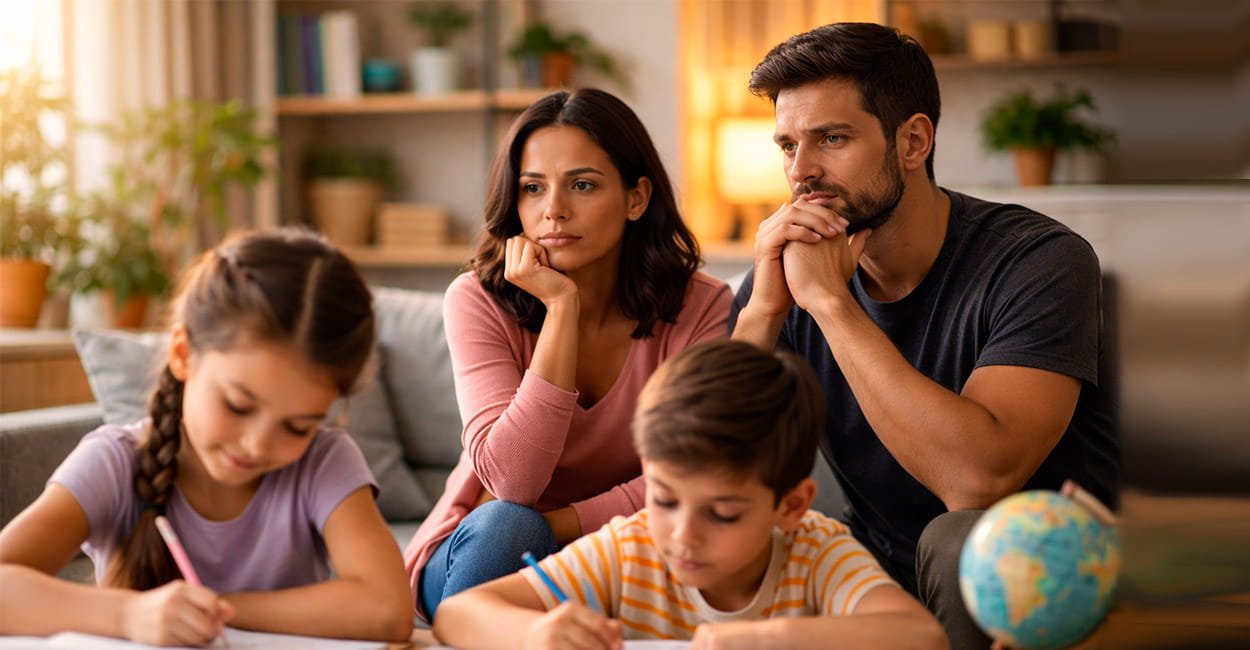
Have you ever noticed how easy it is to worry about test scores, but difficult to know whether your child is learning what truly matters? The topic Children & Education has never been so complex. Many parents follow homework, school meetings, and report cards. Yet deep down, a silent question arises: am I preparing my child only for school, or for the real world?
Today, education involves dealing with technology, information overload, new careers, and rapid social change. Children’s development depends not only on school content, but also on experiences, examples, and daily decisions made at home.
This article works as a central guide, helping you view education in a broader, more strategic, and more conscious way.
What does children & education really mean today?
For a long time, education was almost synonymous with academic performance. Getting good grades meant being on the right path.
Today we know that this is only part of the equation.
Children & Education involves intellectual, emotional, and social development. It means teaching children how to deal with frustration, build autonomy, make responsible decisions, and adapt to change.
School delivers content.
Family builds structure.
When these two pillars work together, development becomes stronger and more consistent.
The silent influence of parents on child development
A large part of education happens outside formal conversations. It appears in everyday details.
The way parents react to mistakes, solve conflicts, talk about money, or deal with traffic teaches far more than any speech.
Children learn through observation. They internalize behaviors even before they fully understand concepts. If an adult loses control over small problems, the child learns that frustration is handled through emotional outbursts. If the adult chooses dialogue, the child learns communication.
In Children & Education, example is always stronger than theory.
Playing is also learning
There is an important difference between entertainment and stimulation.
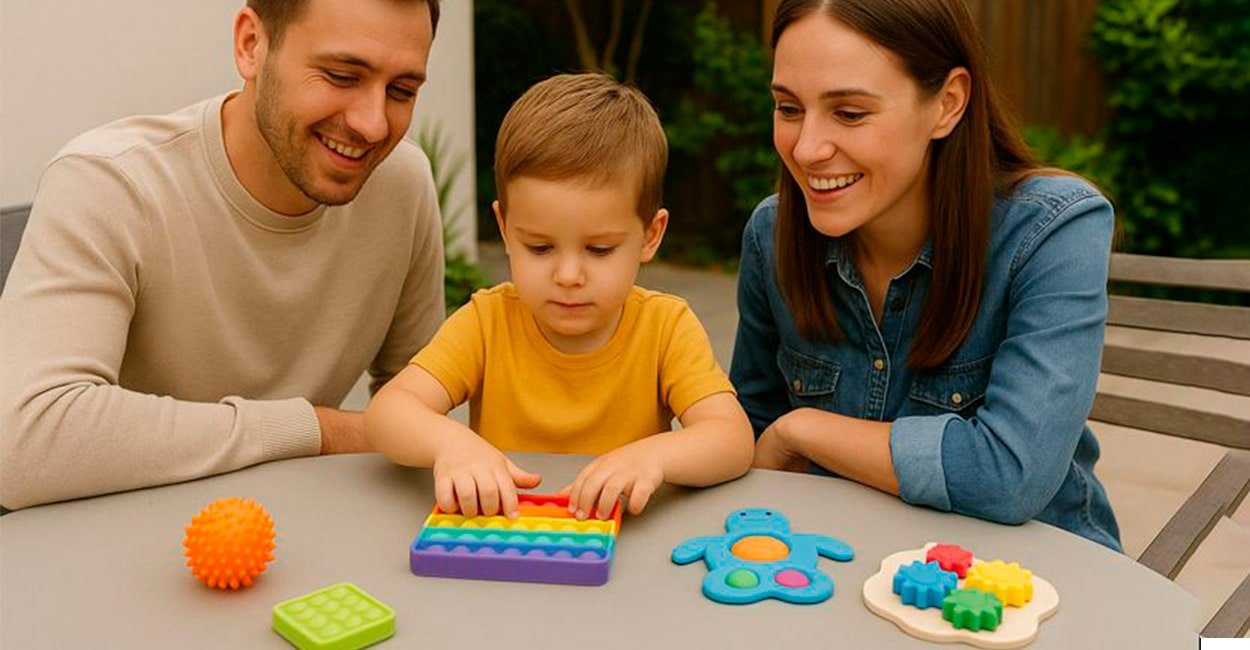
Educational sensory toys, when chosen intentionally, help develop coordination, perception, and concentration. But the toy alone does not educate. What truly makes a difference is interaction.
When an adult participates, asks questions, stimulates curiosity, and guides the activity, learning becomes deeper. The child does not just play. They interpret, test hypotheses, make mistakes, and try again.
Child development happens through repeated and meaningful experiences, not simply through the object itself.
Education beyond a diploma: the value of practical skills
For decades, a diploma was seen as the main indicator of professional success. Studying, graduating, and seeking stability seemed like a linear path. However, the job market has changed and continues to change at a rapid pace.
Professions disappear, new ones emerge, and work models transform. Automation, artificial intelligence, the digital economy, and entrepreneurship have completely reshaped the professional landscape.
In this context, simply accumulating technical knowledge is no longer enough.
The new professional profile
Companies and organizations increasingly seek professionals who can:
- Solve complex problems.
- Communicate ideas clearly.
- Work as part of a team.
- Adapt to change.
- Learn continuously.
- Make autonomous decisions.
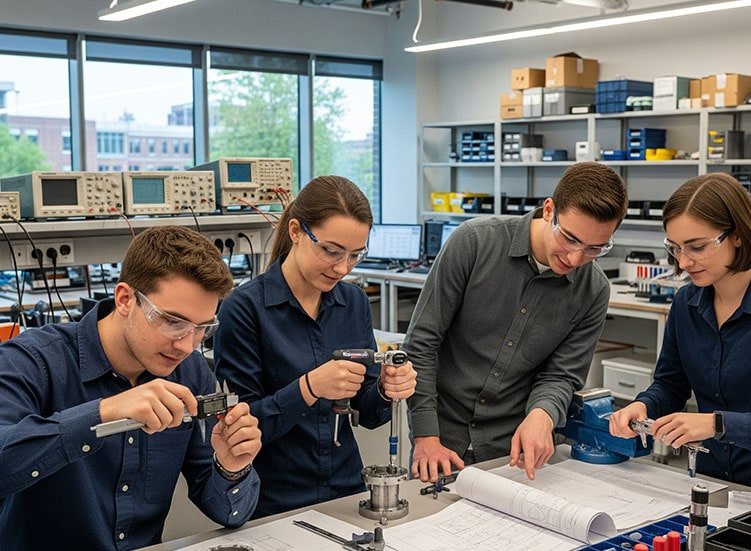
These competencies are not learned only through tests or textbooks. They are developed throughout life and they begin in childhood.
The foundation of a future career is built long before the first résumé.
Technical knowledge is important, but it is not enough
This does not mean undervaluing school or academic education. Formal knowledge remains essential. It structures thinking, expands perspective, and opens doors.
The central point is that a diploma alone does not guarantee readiness for an unpredictable world.
A child may master school content and still struggle to:
- Work under pressure.
- Communicate with confidence.
- Take initiative.
- Deal with frustration.
- Organize priorities.
Without these practical competencies, knowledge loses its power.
Where are practical skills developed?
Practical skills are not built only in specific courses. They are shaped in everyday life.
When a child:
- Participates in simple decisions at home.
- Organizes their own school materials.
- Takes on small responsibilities.
- Learns to manage an allowance.
- Resolves conflicts with siblings or classmates.
- Plans a small personal project.
They are developing autonomy, responsibility, and critical thinking.
These seemingly simple experiences teach mental organization, awareness of consequences, and the ability to adapt.
Autonomy: the guiding thread at every stage
The most important practical skill is autonomy.
It does not arise from the absence of guidance, but from the conscious presence of parents.
Guiding, allowing attempts, letting mistakes happen, and reflecting on those mistakes builds inner confidence.
When a child learns to think independently, they develop something no diploma can guarantee: adaptability.
Expanded education: shaping well-rounded individuals
Education beyond a diploma means shaping individuals who are able to:
- Learn continuously.
- Reinvent themselves.
- Collaborate.
- Lead.
- Create solutions.
Today’s world values those who know how to apply knowledge, not just accumulate it.
For this reason, expanding the concept of learning means integrating:
- School.
- Family.
- Practical experiences.
- Personal projects.
- Socio-emotional development.
The goal is not only to raise high-performing students, but adults prepared for a dynamic and uncertain environment.
How to develop practical skills at each stage of childhood
👶 Ages 3 to 6: basic autonomy and early responsibility
At this stage, children are forming their understanding of responsibility, organization, and consequences.
Practical examples:
- Putting away their own toys after using them.
- Choosing between two clothing options.
- Helping organize their backpack.
- Participating in small decisions (which fruit to bring, which story to read).
- Completing simple tasks, such as watering a plant.
What is being developed:
- Sense of responsibility.
- Organization.
- Decision-making ability.
- Understanding consequences.
Even simple tasks teach that actions generate results.
🧒 Ages 7 to 10: problem-solving and organization
At this stage, children can handle more structured challenges and begin to understand planning.
Practical examples:
- Organizing their own study routine with supervision.
- Managing a small allowance.
- Planning a school project in stages.
- Resolving minor conflicts with peers before adult intervention.
- Helping organize a simple family event.
What is being developed:
- Planning.
- Time management.
- Basic financial responsibility.
- Communication.
- Strategic thinking.
At this stage, mistakes become an important learning tool.
👦 Ages 11 to 14: critical thinking and decision-making
Pre-adolescence is a crucial period to strengthen intellectual autonomy.
Practical examples:
- Participating in more complex family decisions.
- Planning and executing a small project (such as selling handmade items or creating educational content).
- Researching and comparing information before making a purchase.
- Creating a personal study schedule for exams.
- Solving everyday problems without immediate parental solutions.
What is being developed:
- Critical thinking.
- Analytical skills.
- Mental organization.
- Expanded responsibility.
- Self-confidence.
This is where an entrepreneurial and adaptive mindset begins to take shape.
🧑 Ages 15 to 18: leadership and preparation for the real world
During adolescence, preparation for the job market and adult life needs to become stronger and more intentional.
Practical examples:
- Internships, volunteer work, or community projects.
- Active participation in family financial decisions.
- Setting short- and medium-term goals.
- Developing personal projects (digital or in person).
- Simulating a monthly budget.
What is being developed:
- Real responsibility.
- Strategic planning.
- Long-term vision.
- Emotional intelligence.
- Adaptability.
At this stage, the child stops being just a student and begins to become a protagonist of their own journey.
Is technology part of modern education?
Ignoring technology does not protect children from the digital world, it only leaves them poorly prepared for it. The question is not whether technology should be part of education, but how it will be integrated into child development.
We live in a reality where digital skills are as essential as reading and writing. However, technology in education does not simply mean placing a screen in a child’s hands. It means transforming devices into tools for building knowledge.
Technology as a cognitive tool
When used with educational intention, technology can stimulate:
- Logical thinking.
- Problem-solving.
- Intellectual autonomy.
- Creativity.
- Mental organization.
- Research and analytical skills.
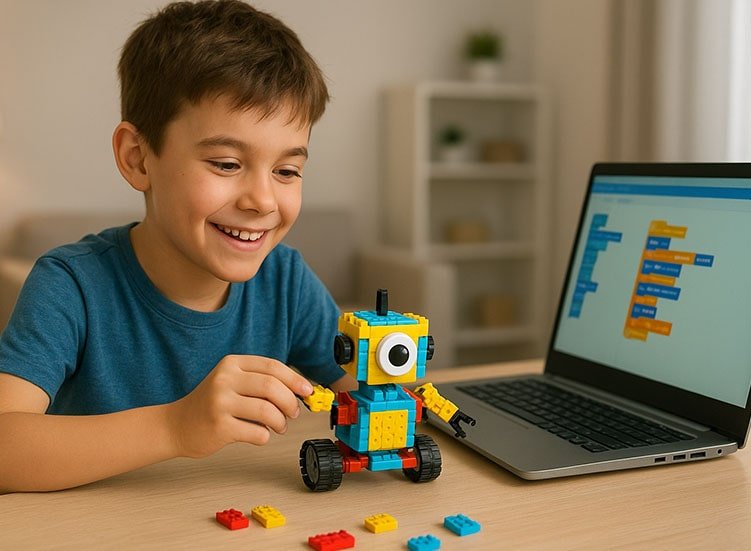
Educational programming and robotics, for example, are not meant to create early software developers. They develop structured reasoning, understanding of cause and effect, planning, and persistence in the face of mistakes, competencies directly connected to academic performance.
When a child learns that a command generates a specific action, they internalize mathematical, sequential, and strategic concepts.
From passive consumption to digital leadership
One of the biggest risks of technology is passive consumption. Endless videos and purposeless games do not build repertoire; they simply stimulate instant rewards.
On the other hand, when a child creates something using technology, the scenario changes completely.
Producing a short digital story, building a presentation, creating a simple e-book, or developing a small project transforms the child from a consumer into a creator. This shift strengthens:
- Self-confidence.
- Verbal and written expression.
- Idea planning.
- Creative thinking.
- Digital responsibility.
The difference lies not in the device, but in the mindset behind its use.
The role of parents in technology mediation
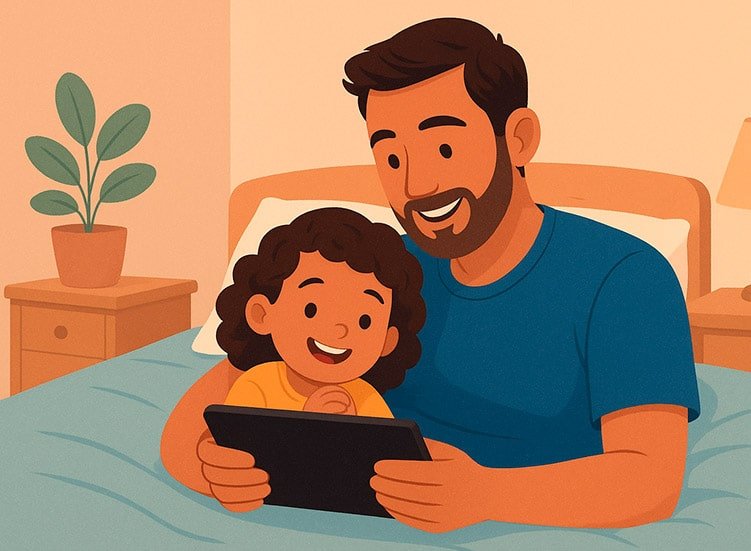
Supervision does not mean constant surveillance, but active guidance. Mediation involves:
- Setting appropriate usage time limits.
- Selecting high-quality content.
- Discussing what was watched or created.
- Encouraging critical reflection.
Simple questions such as “What did you learn from this?” or “How would you do it differently?” transform technology use into structured learning.
Technology and socio-emotional skills
When properly guided, technology can also strengthen socio-emotional competencies. Online collaborative projects, for example, teach cooperation and communication. Solving digital challenges develops resilience and persistence.
The problem is not the screen itself, but its directionless use.
The true balance
Completely banning it may generate uncontrolled curiosity. Allowing it without criteria may lead to dependency and distraction.
Balance lies in three pillars:
- Educational intention.
- Clear limits.
- Active parental involvement.
When a child understands that technology is a tool for creation, learning, and problem-solving and not just entertainment, development becomes deeper and more strategic.
Modern education does not replace books with screens. It integrates tools to expand possibilities.
Do educational games really work in children & education?
They work when there is educational intention.
Educational games that are carefully selected stimulate memory, strategy, language, and reasoning. However, the impact increases when there is mediation. Talking about the game, asking what the child thought before making a decision, and encouraging reflection expand the learning experience.
Without this guidance, the game becomes just a pastime.
When it comes to Children & Education, the difference almost always lies in the active presence of parents or guardians.
What science has already shown about child development
Studies in neuroscience indicate that the first years of life are decisive for the formation of brain connections. The richer and more balanced the environment of stimulation, the greater the positive impact on cognitive and emotional development tends to be.
Research also shows that children exposed to consistent dialogue, reading, and family interaction demonstrate better academic performance and greater emotional stability.
In addition, global reports on the future of work highlight competencies such as critical thinking, creativity, and emotional intelligence among the most relevant for the coming decades.
These findings reinforce that Children & Education cannot be limited to curriculum content alone. A holistic approach to development is essential.
 FAQ Frequently Asked Questions about Children & Education
No. Education begins at home, from the earliest years of life. It is within the family environment that a child learns values, boundaries, responsibility, empathy, and organization. School expands and systematizes academic knowledge, but the emotional, behavioral, and even cognitive foundation is built primarily through daily interaction with parents or guardians. Routines, dialogue, and example have a direct impact on development within Children & Education.
Yes, as long as they are chosen with educational intention. Toys that stimulate motor coordination, logical reasoning, creativity, language, or problem solving contribute to cognitive and socioemotional development. What matters most is not the price or the technology involved, but the type of stimulation they provide and the interaction between the child and the adult during play. This interaction is a key factor in Children & Education.
Yes, especially when the teaching approach is adapted to the child’s age group. Programming develops logic, critical thinking, problem solving skills, and creativity. For younger children, playful and visual activities are ideal. For older ones, simple and educational tools work best. The goal is not to create early programmers, but to encourage structured thinking and intellectual autonomy, which strengthens Children & Education in the long term.
They are essential. Competencies such as self control, empathy, persistence, communication, and emotional intelligence directly influence academic performance and the ability to handle challenges. Children who develop socioemotional skills tend to build stronger relationships, have higher self esteem, and be better prepared for the job market in the future. These are central aspects of Children & Education.
Balance comes from conscious use. Technology should not be banned, but guided. Setting time limits, supervising content, and prioritizing educational tools help transform screens into allies rather than villains. It is also essential to guarantee time for free play, outdoor activities, and family interaction. This promotes healthy and complete development within Children & Education.
🔗 More reading about Children & Education
- Educational sensory toys, how to choose options that truly support child development
- The back seat, how parents’ words and actions influence child development
- Practical skills in education, discover why they’re worth more than just a degree
- Coding and robotics for kids, how to prepare your child for the digital future
- Creating children’s e-books, 6 steps to create and sell using artificial intelligence
- Educational games for children, ideas to stimulate each age group
Conclusion about Children & Education
Educating is not just about following school assignments. It is about shaping character, encouraging critical thinking, and building autonomy.
The topic Children & Education involves daily choices that shape the adult of the future. Small consistent actions, more than big speeches, create lasting results.
By exploring the content in this category, you expand your perspective on how to prepare children not only for exams, but for real-life challenges.
Click here for more content about Children & Education.